

Photo by Andrey Matveev on Unsplash
- 🥇 Best Overall: Anker Soundcore Space A40 ($99)
- 🥈 Best Ultra-Budget: CMF by Nothing Buds 2 ($24.50)
- 🥉 Best for AI Features: EarFun Air Pro 4+
- 🎯 Best Open-Ear: EarFun Clip 2
- 🔷 Best for Adaptive Sound: TOZO EarTune AI Series
What's on the Table
$24.50. That's the entry price — as of June 26, 2026 — for a pair of earbuds that SoundGuys' lab testing confirmed achieves an MDAQS score of 4.8/5, matching the acoustic benchmark of Sony's flagship WF-1000XM6. According to reporting aggregated by Google News from multiple audio review publications including RTINGS.com, SoundGuys, and What Hi-Fi?, budget wireless earbuds have crossed a meaningful performance threshold this year, with sub-$100 options now delivering what industry analysts estimate as 80–85% of premium performance at 20–30% of the cost.
The broader market data confirms the shift. As of June 26, 2026, the global wireless earbuds market is valued at $63.3 billion, growing from $57 billion in 2025 — an 11% year-over-year expansion. The $50–$150 budget segment captured 45.05% of total wireless earbuds revenue share in 2025, signaling a mainstream consumer realignment away from flagship pricing. Apple maintains 23% of global TWS unit market share but captures 44% of revenue in Q1 2026 through premium AirPods pricing — a gap that budget brands are methodically closing from below.
CMF by Nothing's June 2026 launch of the Buds 2 at $24.50 promotional pricing triggered visible price competition across the budget tier. EarFun's CES 2026 debut of live AI translation in sub-$100 earbuds confirmed that feature democratization is accelerating, not plateauing. What Hi-Fi? stated it plainly: "The best cheap earbuds can certainly outperform some more expensive pairs during testing." The five picks below make that case with specific numbers.
🥇 Best Overall: Anker Soundcore Space A40 ($99)
RTINGS.com names the Anker Soundcore Space A40 as the top budget wireless earbuds pick for 2026 — and the specification sheet backs the verdict. Adaptive ANC reduces ambient noise by up to 98%. Total playtime with the charging case reaches 50 hours. The price sits at $99. This is the one most people should buy.
The Space A40's ANC architecture uses adaptive algorithms that continuously sample the acoustic environment and recalibrate cancellation in real-time — the same fundamental approach found in earbuds priced two to three times higher. The 50-hour battery figure reflects case-assisted total runtime, but standalone playback holds up through multiple full days for most commuters without a recharge. Anker Soundcore also introduced modular design and repairability features in its 2026 lineup in response to EU right-to-repair regulations that took effect this year — a long-term durability consideration that adds quiet value to a $99 purchase.
Skip the Space A40 if open-ear awareness during outdoor activity is your priority — it's a sealed in-ear design — or if $99 exceeds the budget ceiling and audio fidelity is secondary. For commuters, remote workers, and gym regulars who want dependable noise cancellation and all-day battery at a price that doesn't require justification, this is the clear recommendation.
Anker Soundcore Space A40 on Amazon →
🥈 Best Ultra-Budget: CMF by Nothing Buds 2 ($24.50)

Image: us.nothing.tech — © manufacturer (official product image)
Nothing's budget sub-brand launched the CMF Buds 2 at $24.50 promotional pricing in June 2026, immediately repositioning what sub-$30 earbuds are expected to deliver. SoundGuys — whose testing methodology measures battery life at 75dBSPL with ANC enabled rather than the low-volume, ANC-off conditions manufacturers typically use for spec sheets — found 83% average noise reduction and awarded an MDAQS audio fidelity score of 4.8/5. Their assessment: sound quality and ANC performance that "genuinely competes with earbuds costing twice as much."
Matching the Sony WF-1000XM6 on MDAQS at a fraction of the price is not a marketing claim — it's a lab result that resets the category's value calculus. The CMF Buds 2 price range extends to $72.64 depending on configuration, which still lands well under the Space A40's ceiling. The trade-off is finish quality and ecosystem depth, not core audio or ANC performance. Battery longevity is also worth noting: industry data indicates wireless earbuds across all price tiers average a 1–3 year lifespan, with battery degradation being the primary limiting factor rather than driver quality. A $24.50 replacement cycle every two years is a rational strategy for the value-conscious buyer.
This is the pick for the skeptic who needs data before trusting a sub-$30 price tag. The data is here.
CMF by Nothing Buds 2 on Amazon →
🥉 Best for AI Features: EarFun Air Pro 4+

Image: myearfun.com — © manufacturer (official product image)
EarFun unveiled live AI-translation capability in the Air Pro 4+ at CES 2026, bringing real-time language translation to sub-$100 earbuds for the first time at this price point. The feature set extends to meeting transcription and AI-driven audio environment optimization. Industry analysis from Wantek describes 2026's leading earbuds as featuring "deeply integrated, on-board AI that continuously analyzes your audio environment, health metrics, and content type to autonomously optimize the listening experience in real-time" — the Air Pro 4+ ships with a version of that architecture at a budget price.
Real-time language translation previously required premium-tier hardware at $200–$300. Its arrival below $100 is the kind of feature migration that redefines a product category's competitive floor. Bluetooth LE Audio and Auracast standard support is also included, enabling universal audio sharing and ultra-low latency that previously required proprietary protocols — both features that reached mainstream budget earbuds broadly in 2026. For frequent travelers, multilingual professionals, or anyone who sits through video calls where transcription matters, the Air Pro 4+ is a more compelling pick than any earbud that charges double for raw ANC performance.
Note the trade-off clearly: if the primary decision criterion is peak ANC percentage, the Space A40's 98% benchmark leads this list. Choose the Air Pro 4+ specifically when the AI feature set is the reason you're buying.

Photo by Mubariz Mehdizadeh on Unsplash
🎯 Best Open-Ear: EarFun Clip 2
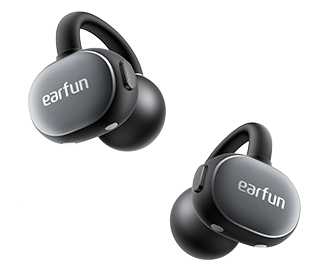
Image: myearfun.com — © manufacturer (official product image)
Open-clip earbuds are the fastest-growing wireless audio form factor in 2026: as of June 26, 2026, open-clip and open-ear shipments are forecast to increase 72% year-over-year — a growth rate that outpaces every other earbud category. The EarFun Clip 2, also debuted at CES 2026, brings this form factor to a sub-$100 price point and represents the most accessible entry into open-ear listening for budget-conscious buyers.
The Clip 2's design wraps around the outer ear without occluding the canal, leaving full environmental awareness intact during outdoor movement. Runners, cyclists, and walkers in urban environments — where situational awareness is a safety requirement — will find this design meaningfully more appropriate than any sealed in-ear option. The trade-off is direct: without an acoustic seal, passive noise isolation is minimal and ANC becomes largely redundant. This is not an office noise-cancellation pick.
EarFun's CES 2026 lineup — including both the Air Pro 4+ and the Clip 2 — ships with Bluetooth LE Audio and Auracast support, so the ultra-low latency audio architecture carries across both products. For buyers choosing between the Air Pro 4+ and the Clip 2, the decision is fundamentally about sealed versus open fit, not feature parity.
🔷 Best for Adaptive Sound: TOZO EarTune AI Series
TOZO's 2026 budget lineup earns its place in this roundup on one specific differentiator: EarTune AI. Where most budget earbuds apply static EQ presets or offer basic manual adjustments, TOZO's EarTune AI algorithms analyze individual hearing profiles in real-time and adapt sound output dynamically. The TOZO EarTune AI earbuds bring genuine audio personalization to the budget bracket — a capability that premium brands have used as a product-tier differentiator for years.
The real-time adaptive model addresses a genuine friction point: factory EQ profiles are calibrated to average hearing curves, not individual ones. Listeners who find that default sound signatures feel slightly off across every pair of earbuds they try are often responding to exactly this gap. TOZO's approach — continuously adjusting to the listener's profile and content type — applies to podcasts, music, and voice calls independently, reducing the manual adjustment overhead that makes EQ customization impractical for most people.
The honest trade-off: TOZO doesn't offer the peer-reviewed ANC benchmarks of the Space A40 or the MDAQS score of the CMF Buds 2. This pick is for listeners who have concluded that sound personalization matters more to their daily experience than published noise-cancellation percentages.
TOZO EarTune AI Earbuds on Amazon →
Chart: ANC noise reduction performance for the two budget earbuds with published lab benchmarks. Space A40 data from RTINGS.com; CMF Buds 2 data from SoundGuys testing at 75dBSPL with ANC enabled, as of June 26, 2026.
Which Fits Your Situation
Choose the Anker Soundcore Space A40 if you want the highest-rated all-around performer under $100. Commuters and remote workers who need dependable ANC for extended stretches will get the most from its 98% adaptive cancellation and 50-hour total battery life. This is the default recommendation for the undecided buyer.
Choose the CMF by Nothing Buds 2 if price is the primary filter and you need data — not just marketing copy — before trusting a $24.50 earbud. The 4.8/5 MDAQS score and 83% average noise reduction from SoundGuys' real-world testing methodology are the data you need.
Choose the EarFun Air Pro 4+ if you travel internationally, work in multilingual settings, or attend meetings where transcription would save time. The live AI translation feature alone makes this pick functionally distinct from every other option on this list.
Choose the EarFun Clip 2 if you run, cycle, or spend meaningful time outdoors and situational awareness matters more than noise isolation. Open-ear design is a safety and comfort decision first — treat it that way.
Choose the TOZO EarTune AI Series if you've cycled through multiple earbuds and found that no default EQ profile ever quite sounds right to your ears. Real-time adaptive audio personalization at a budget price is TOZO's specific, narrow advantage in this roundup.
Frequently Asked Questions
Are budget wireless earbuds actually worth it in 2026?
The evidence is clear: yes. SoundGuys' lab testing confirmed that the CMF by Nothing Buds 2 — priced as low as $24.50 as of June 26, 2026 — achieves a 4.8/5 MDAQS audio fidelity score, matching Sony's flagship WF-1000XM6. What Hi-Fi? has independently concluded that budget earbuds "can certainly outperform some more expensive pairs during testing." The $50–$150 budget segment captured 45.05% of total wireless earbuds revenue share in 2025 because consumers have been reaching this conclusion in large numbers. The performance gap between cheap and premium earbuds has genuinely narrowed.
How long do wireless earbuds last — and does paying more buy longevity?
Industry data places the average wireless earbud lifespan at 1–3 years regardless of price, with battery degradation identified as the primary limiting factor rather than driver or audio quality decline. This finding has a direct implication for budget buyers: a $24.50 pair and a $300 pair run on the same battery chemistry and degrade on similar timelines. Paying more does not meaningfully extend lifespan. Buying budget and replacing on a 2–3 year cycle is a financially rational strategy supported by the data.
Anker Soundcore Space A40 vs. CMF by Nothing Buds 2: which should I buy?
Buy the Space A40 ($99) if you want the benchmark ANC performer with 50-hour total battery life and a more refined build. Buy the CMF Buds 2 ($24.50) if you want lab-verified audio performance at a price that makes replacing them painless. The Space A40 leads on adaptive ANC (98% vs. 83% noise reduction) and ecosystem polish. The CMF Buds 2 matches it on MDAQS audio fidelity scoring at a fraction of the cost. The decision is whether the 15-percentage-point ANC gap justifies a 4x price difference for your specific use case — commuters in loud transit environments will say yes; casual listeners will say no.
Bottom Line
The Anker Soundcore Space A40 is the right call for most buyers: 98% ANC, 50-hour battery, $99, and an RTINGS.com endorsement that reflects rigorous comparative testing across the budget tier. If that price ceiling doesn't fit, the CMF by Nothing Buds 2 at $24.50 is not a compromise — it's a legitimately strong alternative backed by SoundGuys' lab numbers. The EarFun Air Pro 4+ and Clip 2 serve real use cases (AI translation and open-ear safety, respectively) that the top two picks don't address. TOZO's EarTune AI lineup fills the personalization gap.
In my analysis, the most underreported story in this category is the CMF Buds 2's MDAQS result. A 4.8/5 score at $24.50 — matching Sony's flagship on a perceptual fidelity metric — is the kind of data point that should change how buyers approach the budget tier. I'd argue that any shopper spending over $150 on earbuds without first evaluating these five options is paying for brand confidence rather than demonstrated performance.
Disclaimer: Product rankings are based on publicly available reviews, specifications, and consumer reports as analyzed from multiple audio publications including RTINGS.com, SoundGuys, and What Hi-Fi?. We earn a small commission on qualifying Amazon purchases at no extra cost to you. Research based on publicly available sources current as of June 26, 2026.