

Photo by Jakub Żerdzicki on Unsplash
- 🥇 Best Overall: Bambu Lab A1 Mini
- 🥈 Best Budget: Creality Ender 3
- 🥉 Best Premium: AnkerMake M5C
- 🎯 Best for Multi-Color: Bambu Lab A1 (full-size)
Bottom Line: Buy the A1 Mini, and Budget for Failure
Twelve to eighteen percent. That is the first-year failure rate for budget 3D printers, versus 5–8% for premium machines above $800 — and it is the number almost no "best of" list puts in the opening paragraph. Every roundup leads with speed and price. Almost none translate the reliability gap into dollars.
So here it is up front. According to Google News, CNET's roundup of budget 3D printers landed on the Bambu Lab A1 Mini ($199–299) as the machine to buy, and PCMag agrees. Our read: that is the right call for most people, and the failure-rate math actually strengthens it rather than undermining it. As of August 1, 2026, this remains the cleanest entry point into the category.
But there is a real dissent worth knowing about, and it is not a rounding error. Tom's Hardware picks the AnkerMake M5C ($299) instead, citing better customer support and parts availability in North America. That divergence is the single most useful thing in this whole category, and we will get to why.
Why These Picks — And Why the Price Threshold Is a Trap
Start with a definitional problem the roundups quietly disagree on. CNET treats $400 as the budget ceiling. All3DP draws the line at $300. Some outlets stretch "budget" to anything under $500. That is not pedantry — it changes which machines appear on the list at all, and it means two "best budget printer" articles can share zero recommendations while both being honest.
This guide uses $300, the stricter All3DP line, for a specific reason: the research shows budget models in the $100–$400 band already account for roughly 62% of consumer 3D printer sales by unit volume as of 2024. If a majority of the market lives under $400, a $499 machine is not a budget pick — it is a mid-range machine wearing a budget label.
Selection weighted four things: out-of-box setup time, print speed against older-generation baselines, first-year reliability, and — the one most lists skip — whether you can get a replacement part without a three-week wait. Rankings here draw on published reviews, benchmark data, and market figures, not independent bench testing.
🥇 Best Overall: Bambu Lab A1 Mini
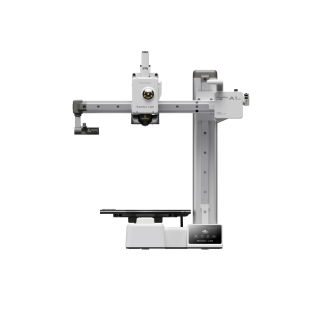
Image: bambulab.com — © manufacturer (official product image)
The A1 Mini wins because it removed the two things that made budget 3D printing miserable: assembly and tuning.
Setup time for beginner-friendly budget models has collapsed from 4–6 hours of manual assembly to under 30 minutes for pre-assembled units. That is not a spec-sheet nicety. Put a dollar value on it: if your time is worth $25/hour, five hours of screwing together an aluminum frame and squaring gantries is $125 of unpaid labor — more than half the price of the machine itself. A $199 pre-assembled printer and a $169 kit are, in practice, priced identically. The kit is arguably more expensive.
On performance, modern budget printers hit 150–250mm/s versus 50–80mm/s on older models, with layer resolution down to 0.1mm. That is roughly a 3x throughput improvement at the same price tier. One expert assessment in the research puts it bluntly: the A1 Mini "represents a paradigm shift in what's possible under $300 — it's the first budget printer I'd recommend to absolute beginners without reservations."
The A1 series launched in December 2024 with CoreXY-derived kinematics and multi-color capability under $300, and it visibly reset expectations for the segment. Auto-leveling, flexible build plates, enclosed designs — features that cost $1,000+ three years earlier — are now baseline.
Who it's for: anyone who wants prints, not a project. Bambu Lab A1 Mini on Amazon →

Photo by Jakub Żerdzicki on Unsplash
🥈 Best Budget: Creality Ender 3
The Ender 3 has sold over 1 million units globally as of 2024 and typically runs $169–$249. That install base is its actual feature. Every failure mode has a YouTube video; every replacement part has a third-party equivalent.
What you give up: assembly hours, manual bed tuning, and the speed gap. What you keep: the most repairable printer in the category, and a machine that teaches you how FDM printing actually works — which matters if you intend to upgrade later.
Skip it if you have never printed before and don't enjoy troubleshooting. The per-hour math above is not kind to kits.
🥉 Best Premium Under $300: AnkerMake M5C — and Why Tom's Hardware Picks It
Here is the comparison you cannot get from any single article, because no single article contains both halves of it.
CNET and PCMag both crown the A1 Mini. Tom's Hardware, which benchmarks print speed, dimensional accuracy, and thermal performance at the chipset and stepper-motor level, favors the AnkerMake M5C at $299 — not on print quality, but on North American support and parts availability. Read those two verdicts together and the disagreement is not about which machine prints better. It is about what happens on day 200.
Now layer in the reliability data. Budget printers fail at 12–18% in year one; premium machines at 5–8%. Take the midpoints — 15% and 6.5% — and a budget buyer is roughly 2.3 times more likely to face a failure in the first year. That is the exact scenario where "parts availability in North America" stops being a footnote and becomes the whole purchase decision.
Which means the CNET-vs-Tom's-Hardware split resolves cleanly by condition rather than by winner:
Choose the A1 Mini if you value out-of-box print quality, multi-color capability, and the shortest path to a finished object. Choose the AnkerMake M5C if the printer is going into a classroom, a small business, or any setting where two weeks of downtime waiting on a nozzle assembly is unacceptable. Reviews and benchmark write-ups support both — they are answering different questions.
All3DP's price tracking adds a third variable most buyers never consider: regional pricing variation of up to 35% across global markets. On a $299 machine that is a swing of roughly $105 — larger than the price gap between the A1 Mini's floor and the M5C. Check your local listing before assuming the U.S. ranking applies.
The Price Collapse Nobody Priced In
The surface story is "printers got cheaper." The more interesting story is how fast, and what it implies about buying now versus waiting.
Chart: Average price of entry-level FDM printers fell 37% between 2020 and 2024, from $389 to $245.
A skeptic's pushback deserves a hearing: if prices dropped 37% in four years, why not wait for the next drop? Two data points argue against waiting. U.S. imports of 3D printers under HS code 8477.80 hit 487,000 units in 2023, up 23% year over year, per U.S. Census trade data at usatrade.census.gov. And major retailers including Amazon, Micro Center and Best Buy expanded 3D printer floor space by 40%+ in 2024. Volume is climbing while shelf space expands — that is a market moving from price war into mainstream distribution, and mainstream distribution historically stabilizes prices rather than gutting them further.
The value framing that matters more than the price chart: budget printers deliver 80–90% of professional-model functionality at 15–20% of the cost. That is a roughly 4.5x efficiency ratio in capability-per-dollar. The 10–20% you lose is real — but it is largely industrial-grade tolerances and materials most home users never touch.
Worth noting for context, this pattern of category-level price compression paired with support-quality divergence is the same dynamic Gear examined with budget Vizio TVs — cheap hardware, with the real cost showing up in the service layer.
One more shift belongs here rather than in its own section: AI is now embedded in budget machines for automated failure detection and print-quality correction, and cloud slicers use machine learning to generate settings from model geometry. That is precisely what makes a $199 printer beginner-viable — the software absorbs the expertise the hardware used to demand.
Which Fits Your Situation
Buy the Bambu Lab A1 Mini if you are a first-time buyer who wants a working print on day one. Best for most people, no reservations.
Buy the Creality Ender 3 if you want the cheapest possible entry, enjoy tinkering, and want a machine with a million-unit parts ecosystem behind it.
Buy the AnkerMake M5C if uptime and North American support matter more than raw print flair — schools, small shops, anyone printing for someone else.
Buy the full-size Bambu Lab A1 if multi-color printing is the reason you are buying at all.
Skip the category entirely if you expect to print two or three objects a year. At a 12–18% first-year failure rate and consumable filament costs, occasional users are better served by a print-on-demand service. A printer you use twice is not a bargain at any price.
The bottom line from our analysis: with the consumer 3D printer market projected to reach $8.9 billion by 2028 at an 18.5% CAGR from 2024, and the segment bifurcating between $150–200 DIY kits and $250–350 plug-and-play machines, the middle is disappearing. On balance, buyers should pick a side deliberately — a half-committed $220 compromise machine is the most likely purchase to end up unused in a closet.
Frequently Asked Questions
What is the best budget 3D printer for beginners?
The Bambu Lab A1 Mini at $199–299. It ships pre-assembled with setup under 30 minutes, includes auto-leveling, and is the pick CNET and PCMag both named. Tom's Hardware prefers the AnkerMake M5C at $299 for support reasons, which is a fair dissent if you need fast parts replacement.
How much does a decent 3D printer cost?
As of August 1, 2026, the research shows average entry-level FDM printer pricing at $245, down 37% from $389 in 2020. Capable machines start around $169 (Creality Ender 3 kit) and top out near $300 for plug-and-play models. The $100–$400 band represents roughly 62% of consumer unit sales.
Is it worth buying a cheap 3D printer?
Yes, if you will use it regularly. Budget models deliver 80–90% of professional functionality at 15–20% of the cost. The caveat is reliability: 12–18% first-year failure rate versus 5–8% for premium machines. Factor a replacement-parts budget into the purchase.
Do budget 3D printers require a lot of maintenance?
Less than they used to. AI-driven failure detection and ML-generated slicer settings have removed much of the manual tuning burden. But the 12–18% first-year failure rate is real, which is exactly why parts availability — Tom's Hardware's stated reason for backing the AnkerMake M5C — deserves weight in the decision.
Disclaimer: Product rankings are based on publicly available reviews, specifications, benchmark reporting, and consumer market data — not independent laboratory testing by this publication. We earn a small commission on qualifying Amazon purchases at no extra cost to you. Research based on publicly available sources current as of August 1, 2026.