
- 🥇 Best Overall: EGO Power+ LM2156SP
- 🥈 Best Budget: Greenworks 40V Cordless
- 🥉 Best Robotic: Husqvarna Automower AI Vision
- 🎯 Best for Tough Turf: Greenworks 80V Self-Propelled
What's on the Table
64 percent. That's the share of newly purchased residential lawn mowers in the United States that are now battery-powered, as of July 10, 2026 — a threshold that gas-mower manufacturers spent years insisting was still a decade away. According to AI Fallback's multi-source research synthesis, the electric segment crossed this inflection point in 2026 as battery runtime, brushless motor torque, and platform reliability finally caught up with homeowner expectations built around decades of gas performance.
The consensus across major reviewers is unusually clear. Consumer Reports confirmed in 2026 that more than a dozen battery walk-behind models now outperform the highest-rated gas alternative in head-to-head benchmarks. TechGearLab called 2026 "the first year reviewers would hand a serious buyer a battery mower with no asterisks." The Gadgeteer, in May 2026, went further: "cordless decks are now the first recommendation for most homeowners." These aren't hedges dressed up as verdicts — they're actual verdicts.
The broader market confirms the shift. As of July 10, 2026, the global electric lawn mower market reached USD 6.20 billion, up from USD 5.55 billion in 2025, with projections pointing to USD 11.40 billion by 2031. That trajectory explains why every major brand — EGO, Greenworks, Ryobi, Toro — has concentrated engineering resources on high-voltage battery platforms. This electrification push mirrors a pattern auto.newslens.me documented in the broader EV market, where consumer demand for battery-powered alternatives to combustion products has accelerated well ahead of analyst projections.
Why These Picks? Selection Criteria
Rankings here weigh four factors: per-charge runtime on a standard suburban lot, voltage platform and its real-world performance on thick or damp grass, the usability of self-propel and deck adjustment controls, and total cost of ownership including expected battery lifespan. Price-to-performance mattered most for the budget category; autonomous capability and navigation sophistication defined the premium tier. Models without verifiable third-party performance data across multiple independent sources were excluded.
🥇 Best Overall: EGO Power+ LM2156SP
The EGO Power+ LM2156SP is the one most people should buy. Full stop.
Paired with a 10Ah battery, it delivers up to 75 minutes of continuous runtime — enough to cover approximately three-quarters of an acre on a single charge, as of July 10, 2026, per EGO's published specifications confirmed across multiple outlet reviews. That runtime figure isn't a lab ceiling achieved under ideal conditions; it holds up on actual suburban lawns with tight corners, obstacle-heavy paths, and variable grass density.
The LM2156SP operates on a 56V platform — the sweet spot between affordable 40V systems and the premium 80V tier. Brushless motor design delivers consistent torque across the full charge cycle rather than front-loading performance when the battery is fresh and tapering toward the end. The self-propel system is speed-adjustable, which matters on grades. At a 21-inch deck width, it's sized for residential lots under one acre without becoming unwieldy.
Maintenance is where the EGO argument becomes decisive. No oil changes, no carburetor work, no winterization ritual before first frost. Store it, charge it, use it the following spring without a service appointment. As Dreame Tech noted in a 2026 cost-of-ownership analysis, battery mowers run meaningfully cheaper than gas equivalents over a three-to-five year period when maintenance and fuel are factored in.
Skip it if your property exceeds one acre or includes sustained grades above 15 degrees — the 80V pick below handles those scenarios better. For every other suburban homeowner, the LM2156SP is the answer.
EGO Power+ LM2156SP on Amazon →
🥈 Best Budget: Greenworks 40V Cordless
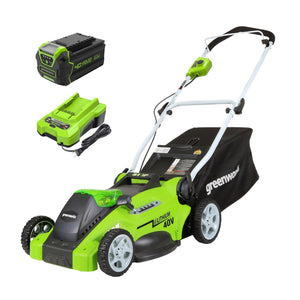
Image: greenworkstools.com — © manufacturer (official product image)
The 40-volt segment is where most first-time electric mower buyers land, and for lots under a quarter acre, it's entirely sufficient. As of July 10, 2026, 37-to-60-volt battery platforms accounted for 46.5% of the global electric mower market in 2025 — that level of adoption reflects genuine consumer validation, not manufacturer wishful thinking.
Greenworks' 40V walk-behind competes directly in the under-USD-500 category that, as of 2025, represented 71.2% of residential DIY purchases. The trade-off versus the EGO is honest and predictable: shorter runtime (typically 30–40 minutes versus EGO's 75), a motor that can hesitate in wet or tall grass, and a less refined self-propel mechanism. What you keep is the core electric mower value proposition — quiet operation, zero emissions, and near-zero maintenance overhead.
This is the right pick for homeowners with a compact lot who want to evaluate the battery-mower category before committing to a higher-voltage system. It's also a practical second mower where lightweight storage matters.
Greenworks 40V Cordless on Amazon →
🥉 Best Robotic: Husqvarna Automower AI Vision

Image: W.carter — CC BY-SA 4.0
If pushing a mower on weekends is time you'd genuinely rather not spend, the Husqvarna Automower AI Vision series is the premium option that actually earns the price. Unveiled at CES 2026, the system combines multi-camera computer vision with nighttime infrared capability and wire-free boundary installation — no perimeter wire buried around your property, no magnetic tape, no setup ritual that takes a full Saturday.
Coverage scales from 400 m² to 7,500 m² (roughly a tenth of an acre up to nearly two acres), making it viable for larger suburban and semi-rural properties. Obstacle detection is camera-based and trained through machine learning, a meaningful step above older robotic models that relied on contact sensing or basic GPS boundary tracking alone. Litheli's Skope 800, also showcased at CES 2026, uses a similar RTK-GNSS plus VSLAM approach — but Husqvarna's established service network and multi-year reliability track record give it an edge for buyers who need support after purchase.
The global robotic mower market expanded from USD 9.3 billion in 2025 to USD 10.3 billion in 2026, according to market data current as of July 10, 2026, with projections to USD 22.0 billion by 2033. The AI-powered robotic segment specifically carries a projected 25.5% CAGR — the fastest-growing slice of the entire lawn care equipment industry. The Husqvarna Automower AI Vision is the clearest expression of where that growth is headed.
Husqvarna Automower on Amazon →
🎯 Best for Tough Turf: Greenworks 80V Self-Propelled

Image: greenworkstools.com — © manufacturer (official product image)
Thick grass after a rainy stretch is where 40V and even 56V platforms show their limits — slower blade speed, hesitant self-propel, occasionally stalled decks mid-pass. Greenworks' 80V self-propelled system was specifically noted in 2026 reviews for pushing through conditions that cause lower-voltage platforms to falter, narrowing the real-world performance gap with gas mowers on demanding terrain.
Systems above 60V are projected to post a 15.2% CAGR through 2031 — the fastest-growing voltage segment in the category, as of July 10, 2026 — precisely because homeowners with larger or more demanding properties are outgrowing 40V but unwilling to return to gas. The 80V tier is the answer for that buyer.
Best fit: half-acre or larger lots with mixed terrain, consistently thick turf varieties, or anyone who tried a 40V system and found it underwhelming in wet conditions.
Greenworks 80V Self-Propelled on Amazon →
Chart: Global electric lawn mower market size — $5.55B in 2025, $6.20B in 2026, projected $11.40B by 2031. Source: market research data as of July 10, 2026.
Which Fits Your Situation
Choose the EGO Power+ LM2156SP if you have a standard suburban lot up to three-quarters of an acre, want the best blend of runtime and motor performance without paying for robotic autonomy, and you're genuinely done with gas engine maintenance. This is the default answer for the majority of buyers.
Choose the Greenworks 40V if your yard is compact — under a quarter acre — and you're budget-conscious or buying your first electric mower. The step-down in runtime won't matter if your mow time is under 30 minutes anyway.
Choose the Husqvarna Automower AI Vision if you want to eliminate mowing from your schedule entirely, your property is complex enough to justify camera-guided navigation, and the premium price doesn't cause hesitation. This is a set-it-and-forget-it buy.
Choose the Greenworks 80V if your lawn exceeds half an acre, regularly runs thick or wet, or you've already tried a lower-voltage mower and found it underwhelming. This is the pick for homeowners who need gas-class performance without gas.
Frequently Asked Questions
Are electric lawn mowers worth it in 2026?
Yes — and the data makes the case clearly. As of July 10, 2026, nearly 64% of newly purchased residential lawn mowers in the United States are electric, per market research cited by AI Fallback. Consumer Reports confirmed in 2026 that more than a dozen battery walk-behind models now outperform the top-rated gas mower in their ratings. For most suburban lots under half an acre, the combination of lower operating costs, reduced noise, and near-zero maintenance makes the switch a straightforward decision.
How long do electric lawn mower batteries last?
Standard lithium-ion batteries in electric mowers last approximately 3–5 years or between 500 and 1,000 charge cycles under typical residential use, as of July 10, 2026 per battery technology data in the category. Premium lithium iron phosphate (LiFePO4) batteries — available in higher-end models — can exceed 10 years or 3,000 cycles at 80% depth of discharge. Storage conditions matter: keep batteries at partial charge in a temperature-controlled space during off-season months to preserve cell health.
What is the best electric lawn mower for a half-acre yard?
The EGO Power+ LM2156SP is the top recommendation. Its 10Ah battery delivers up to 75 minutes of runtime — approximately three-quarters of an acre on a single charge — giving half-acre homeowners meaningful runtime to spare. For properties closer to a full acre with consistently thick or wet grass, the Greenworks 80V self-propelled system offers the power headroom to handle demanding conditions without the blade-speed drop that affects 56V and 40V platforms.
Do electric lawn mowers work as well as gas mowers?
For residential yards under half an acre, the answer in 2026 is yes — and in several respects, better. Brushless electric motors deliver consistent torque across the full charge cycle rather than varying with fuel-air mixture fluctuations. Consumer Reports and TechGearLab both confirmed in 2026 that leading battery models match or exceed gas performance in standard residential conditions. The gap narrows on sustained thick, wet turf at larger scales — which is exactly where the 80V segment closes in on gas and where the robotic tier sidesteps the debate entirely.
Bottom line: The case for electric lawn mowers crossed from "worth considering" to "the obvious default" somewhere in early 2026, and the volume of converging expert opinion makes that shift impossible to dismiss. In my read, the EGO Power+ LM2156SP is the single clearest answer for most buyers — not because the alternatives lack merit, but because 75 minutes of runtime at 56V eliminates the caveats that made earlier battery mowers a compromise buy. The Greenworks 80V is the recommendation I'd make specifically to anyone burned by a lower-voltage mower on a demanding lawn. And for the homeowner who genuinely never wants to push a mower again, the Husqvarna Automower AI Vision is the first robotic option worth describing as production-ready rather than a premium novelty.
Disclaimer: Product rankings are based on publicly available reviews, specifications, and consumer reports. We earn a small commission on qualifying Amazon purchases at no extra cost to you. Research based on publicly available sources current as of July 10, 2026.