

Photo by Rylan Kealey on Unsplash
- 🥇 Best Overall: Roland TD-716
- 🥈 Best for Beginners: Alesis Nitro Max
- 🥉 Best Premium: Roland Professional Flagship
- 🎯 Best Budget Challenger: Donner Groove Series
What's on the Table
58%. That's the share of active drummers who now rely on electronic kits for rehearsals, live shows, and studio sessions — a figure that, as of June 21, 2026, according to Coherent Market Insights, signals just how thoroughly e-drums have moved from apartment compromise to preferred instrument. The global market sits at USD 1.35 billion in 2026 and is on track to nearly double, reaching USD 2.31 billion by 2033, at an 8.0% compound annual growth rate. North America leads with 35.8% of market share; Asia Pacific holds 19.5% and is expanding fastest.
According to MusicRadar — which evaluated more than 90 electronic drum kits for its comprehensive 2026 buyer's guide, as reported by Google News — the category has reached a maturity threshold: 'the world of electronic drums has never offered more choice to drummers of every level, with the best e-kits sounding and feeling closer to acoustic sets than ever before, while features once reserved for high-end kits have trickled down to more affordable setups.' Three forces are accelerating this: Donner entered the professional-level segment with its Groove Series, pressing Roland, Yamaha, and Alesis on pricing; AI-powered tools including Emergent Drums (deep neural network sample generation) and DrumBot AI (chatbot-based groove programming) are beginning to layer onto kit workflows; and Bluetooth connectivity plus USB audio are now baseline expectations in sub-$500 kits, not upgrades.
Roland Corporation, which reported revenue of 104 billion yen for the twelve months ending March 31, 2026, continues to set the benchmark. But the field has never been more competitive. Here are the four picks that cover every realistic use case.
🥇 Best Overall: Roland TD-716
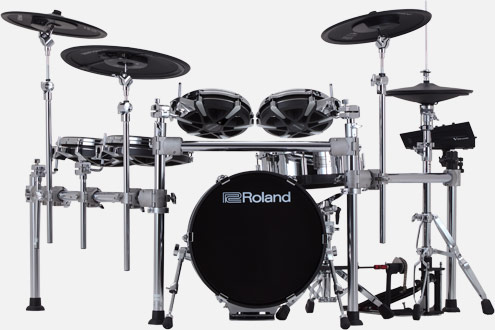
Image: roland.com — © manufacturer (official product image)
The Roland TD-716 is the kit that resolves the most arguments. MusicRadar named it best overall after working through the competitive field, and Drumeo — one of the most-cited drum education platforms — calls Roland 'the undisputed best electronic drum set brand, with the best playability and features in each price range.' The TD-716 sits above the beginner sweet spot of $350 to $850 that Coherent Market Insights identifies as the entry range, but well below the professional flagship tier that exceeds $5,000. That positioning is exactly where it should be for most serious players.
What earns it the top rank is balance rather than any single standout spec. The mesh pads register subtle ghost notes and dynamic gradations that cheaper rubber-pad kits compress into indistinct blobs. The sound module delivers enough preset kits to cover jazz through metal without requiring external sample packs. USB audio output means it connects directly to a DAW or audio interface without additional hardware. Bluetooth handles wireless connection to a streaming source for play-along practice. The trigger response system is the closest this price tier has come to replicating acoustic playing feel — not identical, but close enough that technique developed on the TD-716 transfers cleanly.
Skip it if you're a first-time buyer who isn't yet sure drumming will stick — the investment is harder to justify until commitment is clear. But for anyone practicing seriously, gigging, or wanting a single kit that handles home rehearsal and studio recording, this is the answer most buyers should default to.
🥈 Best for Beginners: Alesis Nitro Max
The Alesis Nitro Max is MusicRadar's explicit recommendation for beginners, and the reasoning is airtight. It lands firmly inside the $350-to-$850 beginner price range identified by Coherent Market Insights as of June 21, 2026, delivers mesh snare and tom pads (a meaningful step up from the rubber pads that made older entry kits feel punishing to practice on), and packs over 300 sounds and 60 preset kits into an accessible module.
Where it compromises versus the Roland: cymbal articulation is less nuanced, trigger response under aggressive playing occasionally stutters, and the overall build reads its price tier honestly. None of that matters for a beginner. What matters is that the Nitro Max sounds good enough to stay motivated, responds accurately enough to build proper technique, and doesn't require a spend that stings if the player loses interest after three months. USB MIDI output, an aux input for drumming along to a phone, and a headphone output for silent practice make it a genuine apartment solution — not just a compromise one.
The Nitro Max is also among the kits that most visibly demonstrate what both MusicRadar and Drumeo note across their coverage: features that were exclusive to prosumer kits two or three years ago have now filtered down to entry pricing. That's the market at work, and beginners are the primary beneficiaries.
🎯 Best Budget Challenger: Donner Groove Series
The name to watch in the mid-range segment is Donner. As tracked by industry sources covering the electronic drums market in 2026, Donner's Groove Series entered the professional-level tier as a direct challenge to Roland, Yamaha, and Alesis — bringing competitive pad sensitivity and a solid multi-genre module to a price point that previously underdelivered on specs.
The Groove Series functions as a value bridge between the beginner tier (below $850) and the prosumer category where Roland dominates. For players who've outgrown the Alesis Nitro Max but can't justify stepping to the TD-716's price tier, Donner offers a credible middle path. Independent buyer feedback highlights above-average pad feel for the price class and a module that layers sounds more convincingly than earlier Donner models. The honest caveat: Donner lacks Roland's decades of pad engineering refinement, the expansion ecosystem of add-on pads and coaching software, and the resale value that established brands hold. For a serious long-term player, those factors favor spending more on Roland. But for an intermediate drummer who wants meaningfully more kit than the Nitro Max without crossing into prosumer pricing, the Groove Series earns its place here.
Donner Groove Series on Amazon →
🥉 Best Premium: Roland Professional Flagship
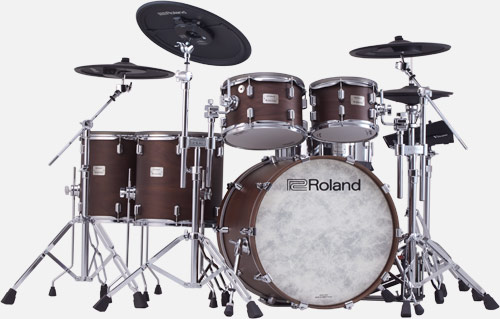
Image: roland.com — © manufacturer (official product image)
The professional segment captures 43.6% of global electronic drums market share as of June 21, 2026, according to Coherent Market Insights — driven by recording studios, touring musicians, and live performance venues that require accuracy no mid-range kit can deliver. Roland's flagship professional kits, priced above $5,000, represent the current ceiling of what electronic drums can do.
At this tier, the gap between electronic and acoustic narrows substantially. Multi-zone pads read stick angle, velocity, and strike position simultaneously. Sound modules at this level include physical modeling — not just layered sample playback — which reproduces the dynamic interaction between drum components that makes acoustic playing feel alive rather than sampled. External MIDI connectivity supports integration into professional production chains. Trigger latency drops to sub-millisecond levels that matter in live performance and studio tracking contexts where timing is measured precisely.
The one honest limitation that every source, including MusicRadar, acknowledges: cymbal feel remains the unresolved problem across the entire category. Electronic hi-hats and crash cymbals still don't replicate the physical response of brass — a gap that session drummers and purists consistently flag. For everything else a professional context demands, Roland's top tier delivers it. The cost is real; so is what it buys.
Roland Professional Flagship on Amazon →
Side-by-Side: How They Differ
Chart: The global electronic drums market is projected to grow from $1.35 billion in 2026 to $2.31 billion by 2033, driven by expanding beginner adoption and sustained professional demand at an 8.0% compound annual growth rate.
The clearest dividing line across these four picks isn't brand — it's pad technology. Rubber pads dominated entry-level kits for years; mesh pads are now standard even in the beginner sweet spot, and multi-zone mesh pads with independent sensing regions define the prosumer and professional tiers. Each step up in pad quality produces a non-linear improvement in playability: the jump from rubber to mesh feels larger than the jump from entry mesh to professional mesh. Budget accordingly.
Sound module quality follows a similar curve. Entry-level modules offer adequate sounds but limited dynamic layering — a soft snare hit and a hard one produce the same sample at different volumes, not a different sound. Mid-range and prosumer modules layer multiple samples across the velocity range, creating a natural dynamic response. Professional modules add physical modeling on top of that sample layer. As a practical heuristic: allocate at least 40% of the total kit budget toward the module quality.
Connectivity is now broadly democratized. Bluetooth, USB audio, and MIDI output appear across kits from $350 upward — a shift reflecting exactly the trend Coherent Market Insights tracks: integration with streaming platforms and DAW software is becoming a baseline feature rather than a tier differentiator. The real differentiation at higher price points is trigger latency, not connection options.
AI integration is worth noting but not yet a purchasing criterion. Emergent Drums and DrumBot AI operate externally to drum modules, generating samples and patterns that players then route in. As one industry analyst summarized the near-future trajectory: 'AI could prove incredibly useful, from configuring our kits to generating the sounds in our head' — the operative word being could. That shift is arriving; it hasn't fully arrived. Buyers should watch it but not wait for it. A parallel dynamic shows up in Smart Picks AI's camera buying guide, which found that AI-assisted features have similarly raised the floor of mid-range gear without yet redefining the premium tier — and that the best current value sits squarely in the middle of the price range, not at the extremes.
Which Fits Your Situation
Choose the Alesis Nitro Max if you're buying for a first-time player, budget ceiling is below $850, or silent headphone practice is the primary requirement. It's the correct first kit for the majority of new players — do not overthink this one.
Choose the Donner Groove Series if you're an intermediate player who has outgrown a beginner kit but can't justify the step up to Roland pricing. Best for the drummer who is serious but not yet at the stage where professional specs are the bottleneck.
Choose the Roland TD-716 if you practice regularly, want a single kit that handles rehearsal, live playing, and home recording, and plan to keep the instrument for five or more years. The resale value, ecosystem support, and playability advantage over competitors justify the price for anyone past the casual-hobbyist stage.
Choose Roland's professional flagship tier if you are a working drummer who needs studio-level trigger accuracy, or if you're equipping a professional recording studio or performance space. The $5,000-plus entry price is real, but so is the performance gap it closes.
Skip electronic drums entirely if you have access to an acoustic kit in a space where volume isn't a constraint. Electronic kits have made extraordinary progress — but the cymbal feel gap is genuine, and no spec improvement in 2026 eliminates it for the player who notices the difference.
Bottom Line
The electronic drums market is in a genuine expansion phase, and the features-per-dollar ratio at every price tier has never been better. The professional segment captures 43.6% of market activity as of June 21, 2026, but the most interesting story is in the beginner-to-prosumer pipeline: the $350-to-$850 entry range has improved enough that new buyers no longer face a serious quality penalty for starting at the bottom. In my analysis, the most consequential development in the category right now is Donner's push into the professional segment — not because Donner will outsell Roland, but because the pricing pressure it creates will force Roland and Yamaha to sharpen their value at mid-tier price points over the next 12 to 24 months. That's good for buyers at every level, and it's the trend worth watching before committing to any purchase above the beginner tier.
Disclaimer: Product rankings are based on publicly available expert reviews, manufacturer specifications, and industry market data. We earn a small commission on qualifying Amazon purchases at no extra cost to you. Research based on publicly available sources current as of June 21, 2026.