

Photo by Michael Maasen on Unsplash
- 🥇 Best Overall: Samsung S95F OLED — $2,499 (55")
- 🥈 Best Value: LG C5 OLED — $1,299 (65")
- 🥉 Best Mini-LED: Hisense U7SG
- 🎯 Best Budget QLED: TCL QM8K
What's on the Table
2,553 nits. That's the peak brightness RTINGS.com recorded from the Samsung S95F OLED — the highest figure ever logged in their lab's history for any OLED panel, as of June 19, 2026. To put that in context: the LG G5, itself a 2026 flagship, peaks at roughly 1,800 nits. The gap between the top two OLEDs is no longer incremental; it's a category-defining step.
According to Google News, citing RTINGS.com's mid-2026 market roundup, six TVs stand above the rest across performance, value, and emerging technology tiers. The lineup: Samsung S95F OLED, LG C5 OLED, Hisense U7SG, TCL QM8K, Samsung S90F OLED, and Samsung S95H OLED. Each earns its placement for a distinct reason — and the 2026 market context makes timing matter more than usual. US reciprocal tariffs introduced in 2025 have reshuffled traditional pricing windows, and OLED production capacity is tightening: supply headroom is projected to decline from 22.3% in 2026 to 17.1% in 2027. The conventional wisdom about waiting for Black Friday deserves scrutiny this cycle.
Why These Picks?
RTINGS.com tested each model using their Test Bench 2.2 methodology, evaluating peak brightness, black uniformity, input lag, color volume, and HDR tone mapping. Consumer Reports now runs more than 300 TV models through evaluation annually, with AI upscaling moving from flagship exclusive to baseline standard — meaning the bar for a credible "best of" slot is meaningfully higher than three years ago.
Four factors drove selection here: real-world picture quality in actual viewing environments (not spec sheet peaks in isolation), gaming readiness, value for screen size, and long-term durability. On that last point, Cinema Config made the most useful observation in recent coverage: "The burn-in conversation has not caught up to where the technology actually is. Both QD-OLED and traditional WOLED technologies have become mature enough that burn-in resistance should not be a major deciding factor for most consumers." OLED lifespan has tripled to 100,000 hours — equivalent to 10 to 20 years under normal viewing conditions. That anxiety belongs to another era.
🥇 Best Overall: Samsung S95F OLED ($2,499 / 55")
The S95F is the brightest OLED RTINGS.com has ever measured, hitting 2,553 nits in Standard mode as of June 19, 2026. That figure matters specifically in mixed-light rooms where conventional OLEDs wash out during daytime viewing — the S95F punches through ambient light at a level its predecessors couldn't approach. What Hi-Fi called it "an exceptional OLED that in any other year would be head and shoulders above the competition — even in the face of 2025's cohort of next-gen flagships, it's among the very best."
The panel runs Samsung's NQ4 AI Gen3 processor, using 128 neural networks — six times more than the previous Gen2 chip — to handle real-time HDR remastering, content-type detection, and upscaling of compressed streaming sources. The difference on a degraded Netflix or Max stream is visible and not subtle. The S95F also arrives as the first set ready for Dolby Vision 2, which launched in 2026 supporting up to 10,000 nits peak brightness. That ceiling won't be reached by any panel today, but forward compatibility matters on a set you'll own for a decade.
At $2,499 for the 55", this is not a bargain. For cinema-primary households with controlled lighting that want the absolute best OLED available, nothing at this brightness tier competes. But 55" at that price point will frustrate anyone who wants a larger footprint.
Skip it if: screen size matters more than peak HDR impact, or if bright-room sports is your primary viewing scenario — the C5 at 65" for half the price covers most of what you'd notice day-to-day.
🥈 Best Value: LG C5 OLED ($1,299 / 65")
The LG C5 at $1,299 for 65 inches is the TV most people in this guide should actually buy. Genuine OLED — true per-pixel lighting, perfect black levels, wide off-axis viewing — at a price that was flagship territory just three years ago. As of June 19, 2026, average OLED selling prices have declined from $1,200 in 2023 to $1,000 market-wide, and the C5 sits precisely at the point where the value case for OLED over LCD becomes irrefutable.
For gamers, the C5 is nearly impossible to beat at this price. All four HDMI 2.1 ports support 4K at 165Hz with G-Sync and FreeSync Premium, powered by LG's Alpha 11 AI Processor Gen3. PS5 and Xbox Series X both connect at full bandwidth with no compromises. Input lag is class-leading. The C5 peaks at roughly 1,200 nits in HDR — lower than the S95F's 2,553, but sufficient for meaningful HDR impact across typical viewing environments.
The honest caveat: the C5's built-in speakers are functional but not a strength. What Hi-Fi flagged the Sony Bravia 8 II as the stronger option "if you are determined to live with your TV's built-in speakers" — a legitimate point for anyone who hasn't budgeted for a soundbar. If audio matters and you're allergic to external speakers, that's worth knowing upfront.
Skip it if: your viewing room is genuinely flooded with daylight all day and you watch mostly sports. Otherwise, this is the default recommendation for nearly every buyer reading this.

Photo by Jonas Leupe on Unsplash
🥉 Best Mini-LED: Hisense U7SG
2026 marks the mainstream arrival of RGB Mini-LED as a credible OLED alternative, and the Hisense U7SG is the value entry point into this new category. Mini-LED deploys thousands of individually dimmable zones behind an LCD panel, dramatically improving local dimming and HDR punch versus conventional LED-LCD — without reaching OLED's true zero-black floor. The tradeoff is real; so is the advantage in bright-room brightness headroom.
Mini-LED shipments outpaced OLED for the first time in Q4 2024, and projections show Mini-LED continuing to outsell OLED through 2026 and 2027. Hisense has priced the U7SG to compete directly with mid-tier OLEDs — making it the correct call for daytime sports households, bright living rooms, and buyers who've heard the OLED brightness pitch but found it oversold for their actual environment. For a dedicated home theater? The C5 wins. For a sun-drenched family room? The U7SG earns serious consideration.
The Other Three: TCL QM8K, Samsung S90F & S95H
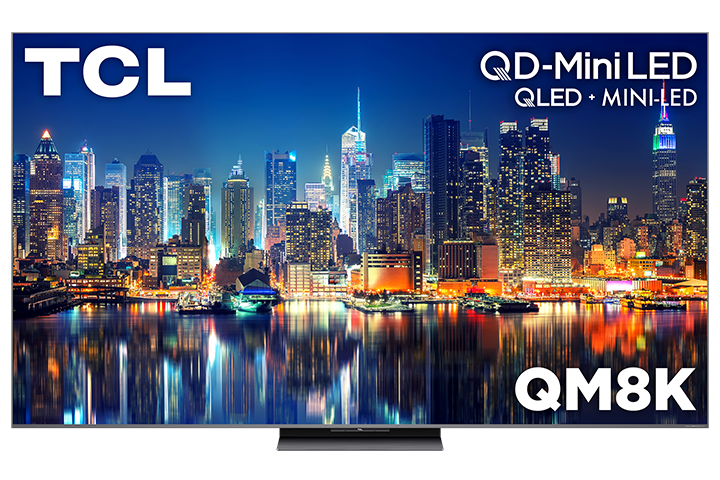
Image: us.tcl.com — © manufacturer (official product image)
The TCL QM8K is the budget QLED/Mini-LED pick for buyers prioritizing screen size above all else. Respectable HDR zone count, aggressive pricing at large diagonals, and enough AI upscaling to handle compressed streaming without embarrassment. It's not as refined as the Hisense U7SG, but for 75"+ at the lowest defensible entry point, TCL's QM8K earns the shortlist. TCL QM8K on Amazon →
The Samsung S90F OLED occupies the middle lane between the C5 and S95F — a QD-OLED panel (quantum dot layered on OLED) that delivers better color volume than traditional WOLED but at a lower brightness ceiling than the S95F. It's the path for buyers who find the S95F's price prohibitive but want QD-OLED's color saturation advantage over standard OLED panels. Samsung S90F OLED on Amazon →
The Samsung S95H OLED is the previous flagship — S95F's predecessor. As of June 19, 2026, inventory price drops make it a legitimate alternative for buyers who want QD-OLED panel quality without the current-generation premium. The Gen3 processor and extra brightness headroom stay with the S95F, but the core panel quality of the S95H line remains exceptional. Samsung S95H OLED on Amazon →
Side-by-Side: How They Differ
Brightness is the cleanest single-axis comparison across this year's OLED lineup. The chart below shows how dramatically the S95F separates itself from the broader field:
Chart: Peak HDR brightness per RTINGS.com Test Bench 2.2 measurements as of June 19, 2026. The S95F's 2,553-nit reading is the highest ever recorded for an OLED display in RTINGS's lab history. The LG G5 is included as a mid-tier flagship reference point; LG C5 represents the value-tier OLED ceiling.
Beyond brightness, the technology split shapes the decision: QD-OLED panels (Samsung S95F, S90F, S95H) deliver superior color volume and higher brightness versus traditional WOLED (LG C5, C-series), but WOLED has historically shown better uniformity at large screen sizes. Mini-LED (Hisense U7SG, TCL QM8K) trades perfect blacks for brightness headroom and lower pricing — a genuine tradeoff, not a deficiency.
The economic timing layer is worth flagging explicitly. Tom's Guide noted that 2026 "breaks from traditional patterns. A strong Super Bowl deal in January or February may actually be a better price than what November offers if tariff-driven price increases have settled in by then." OLED supply headroom declining from 22.3% to a projected 17.1% in 2027 reinforces the case for acting on mid-year pricing rather than waiting for the familiar Black Friday playbook. For a broader look at which consumer tech categories are hitting value inflection points right now, Smart Picks Gear recently mapped the gadget landscape across multiple categories beyond TVs.
Which Fits Your Situation
Choose the Samsung S95F if you have a dedicated viewing space with controlled lighting, HDR accuracy is your primary criterion, and a 55" screen satisfies your room. It is the best OLED on the market as of June 2026, full stop.
Choose the LG C5 if you want the television most people should own — 65" of genuine OLED at $1,299, fully equipped for next-gen gaming, available at a size where the S95F's 55" footprint would feel like a regression. This is the default recommendation for the overwhelming majority of buyers.
Choose the Hisense U7SG if your primary viewing room receives strong daylight and you watch more sports than cinema. Mini-LED's brightness advantage over OLED is real in this specific use case and should not be dismissed.
Choose the TCL QM8K if screen size is the top priority and budget is constrained — going larger for less money, with acceptable HDR performance, is a defensible trade at the QM8K's price tier.
Choose the Samsung S90F or S95H if you want QD-OLED panel quality but the S95F's current-generation price premium is difficult to justify for your use case. Both are legitimate flagships from the prior cycle now available at reduced prices.
Frequently Asked Questions
Is OLED better than QLED for watching movies?
For cinema-primary use in a controlled-light environment, OLED wins decisively. Per-pixel lighting delivers perfect black levels, contrast ratios LCD cannot match, and superior off-axis viewing angles. QLED's traditional advantage is peak brightness in bright rooms — a gap 2026's Samsung S95F (2,553 nits) is aggressively narrowing. For movies in a darkened room, OLED remains the benchmark. For daytime sports in a sun-drenched space, QLED or Mini-LED still earns a real conversation.
How long do OLED TVs last before burn-in?
As of June 19, 2026, OLED panels are rated for 100,000 hours of use — equivalent to 10 to 20 years under normal viewing conditions. Both QD-OLED and traditional WOLED have matured significantly, and Cinema Config states plainly that "burn-in resistance should not be a major deciding factor for most consumers." Reasonable precautions apply — avoid static HUD elements displayed for extended hours — but burn-in is no longer a meaningful deterrent for typical viewing habits.
What size TV should I buy for a 10-foot viewing distance?
At a 10-foot (roughly 3-meter) viewing distance, a 65-inch screen falls squarely within the recommended range for 4K content — the standard guidance targets approximately 1.5 times the screen diagonal for comfortable 4K resolution benefit. The LG C5 OLED at $1,299 for 65" is the natural recommendation at this distance, offering genuine OLED quality at a size well-matched to most living room setups without the price premium of the S95F.
Do I need HDMI 2.1 for PS5 and Xbox Series X?
Yes, if you want full console performance. PS5 and Xbox Series X both support 4K at 120Hz, which requires HDMI 2.1 bandwidth. HDMI 2.0 caps at 4K/60Hz — it works, but leaves measurable performance on the table. The LG C5 provides four HDMI 2.1 ports, all capable of 4K at 165Hz, making it the straightforward gaming pick in this roundup. The Samsung S95F also supports HDMI 2.1, but at $2,499 for 55", the C5's value case for gamers is overwhelming.
Should I buy a TV now or wait for Black Friday 2026?
In prior years, November delivered reliable peak discounts. In 2026, that calculus is genuinely less clear. US reciprocal tariffs introduced in 2025 have disrupted traditional pricing cycles, with Tom's Guide reporting that Q1 Super Bowl deals may represent better value than year-end sales if tariff-driven price increases settle in by November. OLED supply headroom is also declining — from 22.3% in 2026 to a projected 17.1% in 2027 — which could tighten pricing further. Waiting for Black Friday is no longer the guaranteed savings play it once was.
In my analysis, the 2026 television market is the most genuinely competitive it has been in several years — not because every product is exceptional, but because credible options now exist at every tier. The LG C5 at $1,299 for 65" would have been the best TV available at any price just three years ago. I'd argue that's the signal worth acting on, rather than waiting for a pricing window that may not materialize the way it historically has.
Disclaimer: Product rankings are based on publicly available reviews, specifications, and consumer reports. We earn a small commission on qualifying Amazon purchases at no extra cost to you. Research based on publicly available sources current as of June 19, 2026.